
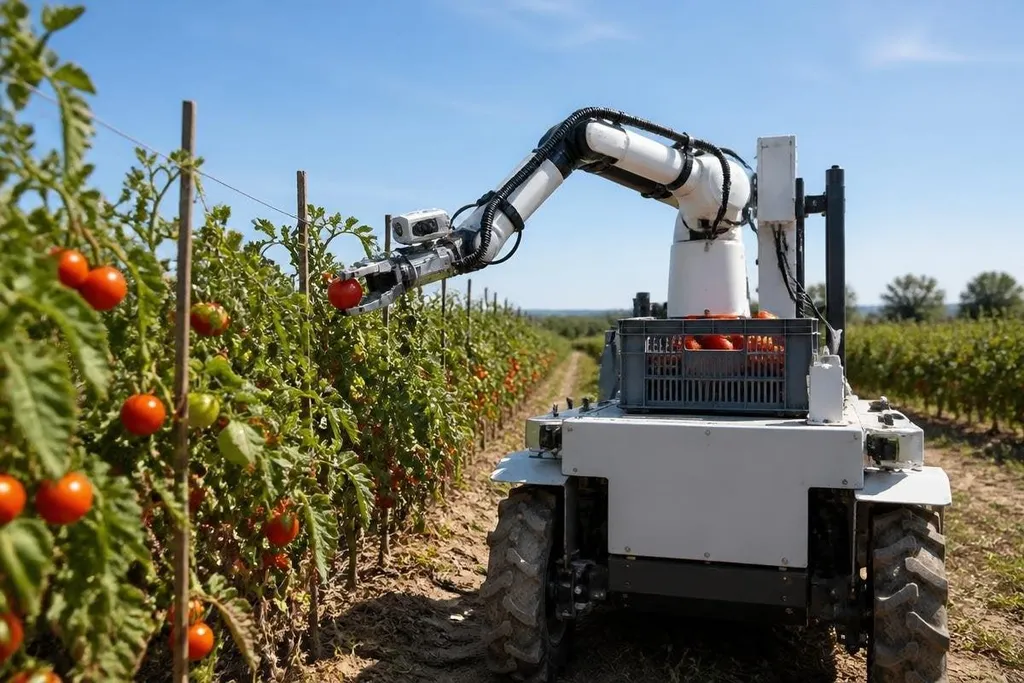
A harvesting robot has to find a ripe crop, pick it without damage, and move on to the next plant. That short task brings together cameras, software, robot arms, grippers, and farm equipment in a setting that changes with every row.
For growers, the question is practical: can a machine collect enough usable produce to justify its cost and fit into daily farm work?
Quick read
- Cameras help the robot find fruit and judge its position before the arm moves.
- Soft grippers reduce pressure on produce that bruises easily.
- The hard test is useful harvest per hour, not a smooth demonstration.
What the robot has to do
A harvesting robot starts with perception. Cameras or other sensors scan plants and separate likely targets from leaves, stems, shadows, and unripe produce. The software then estimates where the crop sits in three-dimensional space.
That estimate guides the arm. The robot must choose a path that avoids branches and nearby fruit, reach the target, and apply enough force to detach it. A small error can leave the crop behind or damage the plant.
The gripper matters as much as the arm. A tool built for a hard crop may crush a soft one, while a gentle tool may fail to hold produce during removal. Some designs use fingers, suction, or cutting tools, depending on how the crop grows and how it comes free.
After picking, the robot has to place the crop into a tray or container. That motion sounds easy until the machine must repeat it across uneven ground, changing light, and plants with different shapes.
Each extra movement adds time and another chance to damage the harvest.
Why farms are testing them
Harvesting takes place during a narrow window. Produce can lose value if it stays in the field too long, yet a crop may not ripen at the same rate across an entire growing area. A machine that can work for long periods could help spread the picking work across that window.
The benefit depends on what the robot can collect and keep. Fast picking can leave damaged produce in the container and create more sorting work. A slower robot may be useful if it selects ripe crops with fewer losses.
Farm work also includes setup, cleaning, charging, repairs, and moving equipment between rows. Those tasks count in the farm's schedule. A robot that needs frequent manual help may reduce the picking burden without reducing the total work.
For a grower weighing a purchase, agricultural robotics reports from Robot24.com can place the crop, harvest date, picking rate, and worker time beside the maker’s claim. That record gives the next section a clear test: where do these systems still need people?
Where the limits remain
Outdoor farms are hard places for machines. Sunlight can change camera images from one row to the next. Leaves can hide fruit, wind can move branches, and mud can affect the vehicle carrying the arm.
The robot also needs a clear rule for uncertain cases. If the software cannot tell whether a crop is ripe, it may skip the target or ask a person to check it. That human review can keep quality high, but it also sets a limit on how much work the machine handles alone.
Cost is another open issue. The price includes the robot, sensors, software, farm changes, maintenance, and trained staff. A grower has to compare that full bill with the cost and availability of seasonal workers, along with the value of the crop that reaches market in good condition.
The strongest opposing view is that farm labor and field conditions vary too much for one robot design to work everywhere. That concern is reasonable. A machine built around one crop, row layout, or picking method may need major changes before it fits another farm.
I'd judge a harvesting robot by its daily harvest record and repair needs, not by how neatly it picks one fruit in a staged test.
A practical buying check
Before a farm commits to a harvesting system, check these points:
- Crop fit: Confirm that the gripper and cutting method match the crop's size, shape, and stem.
- Field fit: Test movement on the real soil, slopes, row spacing, and lighting conditions.
- Quality rate: Measure usable produce, damaged produce, and missed crops in the same trial.
- Human work: Count the time needed for loading, cleaning, supervision, and repairs.
- Service plan: Ask who supplies parts, software fixes, and on-site technical help.
- Payback: Compare the full operating cost with the value of the harvest collected.
Those checks shift the discussion from robot features to farm results. That is where harvesting automation will be judged: how much good produce reaches the container, how often a person must step in, and what the system costs over a full season.
The next useful proof will be repeated field records across changing weather and crop conditions, not another short picking demonstration.